| Interview
with the Dr. Günter Wächtershäuser. |
Entrevista con
el Dr. Günter Wächtershäuser. |
| David
Serquera daserpey@ochoa.fib.es | |
During one month Dr. Wächtershäuser has maitained an interview by e-mail with Huygens about most relevant principles of autotrophic theory of origin of life. Dr. Wächtershäuser makes a thorough analysis of his theory since origins until nowadays. Moreover we treat important questions concerning Astrobiology.
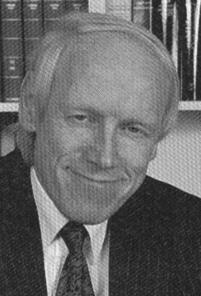 |
| Gunter
Wachtershauser |
Question 1: When did
you start thinking about the origin of life? Which were your inspiration sources?
Answer: I began thinking about the origin of life about 1972/3, when as a patent
attorney I read an article by my former teacher in physical chemistry, Professor
Hans Kuhn (RNA world in the pores of rocks). It was published in "Angewandte
Chemie". At that point I believed naively in the soup theory and that Kuhn
had essentially solved the problem. Beginning about 1973 I became intensely interested
in the epistemology of Karl Popper. Later, in 1982 I met Popper personally. In
the years that followed Popper became my close friend and mentor. My thinking
has been profoundly influenced by Popper. According to Poppers philosophy of knowledge
cultural evolution, including scientific discoveries and technical inventions,
proceeds in the same basic manner as biological evolution: as an unending concatenation
of problems and "attempted" solutions giving rise to new problems and
so forth. I recognized that by going backwards in this concatenation we arrive
at the origin of life as the origin of all problems. I then started an attempt
to develop a general theory of problem evolution, which later was laid aside.
In 1982 William W. Bartley III, a pupil of Popper, invited me to give a lecture
in a philosophical symposium in New York. In the lecture (1983) I related the
work of Hans Kuhn methodologically to the epistemology of Karl Popper. Inspired
by papers by Bartley and the psychologist Donald Campbell I then (1983/4) wrote
a manuscript with the title "Light and Life" in which I traced the origin
of visual perception to photosynthesis. Popper included the thesis in an address
to the Alpbach summer school in 1984. The paper was later published in a philosophical
volume (Wächtershäuser, G. (1987) Light and Life: on the nutritional
origins of sensory perception. In: Evolutionary Epistemology, Rationality and
the Sociology of Knowledge (Radnitzky, G. & Bartley III, W.W. eds.) pp. 122-138.
La Salle: Open Court). This paper marks the beginnings of my methodology of biochemical
retrodiction. In 1982 and 1984 I met Carl Woese, one of the founders of the RNA
world theory. I was introduced to Woese by one of his coworkers, George Fox, who
had looked us up in Munich and with whom I became related when his widowed father
married my wife's widowed mother. From Carl Woese I learned that the soup theory
was seriously flawed and that the problem of the origin of life was anything but
solved. However, at that time I could see no alternative to the soup theory and
so remained captive to that theory.
Question 2: Which was
the methodology employed in the construction of your theory?
Answer: The
conventional methodology of evolutionary reconstruction, called "backward
projection" by Fritz Lipman, is used by almost everybody. It consists of
postulating one-to-one relations of extant functions and precursor functions.
It leads inevitably to an ever increasing collection of precursor functions, since
there is no mechanism of restriction. This means that given the presence of water
we have a prebiotic broth with a chaos of possibilities. I was able to overcome
the weakness of the method of backward projection by developing a methodology,
which I call "biochemical retrodiction". It postulates many-to-one relations
between several disparate extant functions and one common precursor function.
Thereafter several disparate precursor functions are again related to one still
deeper common precursor function and so forth. In this manner, as we go deeper
and deeper, a pattern of overall convergence is generated. Thus this method leads
to one definite primordial organism and not to a primordial soup. My methodology
is a derivative of Poppers principle of "relative explanatory power".
Of two theories the one is selected that explains the most facts by the fewest
assumptions. It is at the same time a derivative of Poppers philosophy of historic
understanding, which he called "situational logic". It consists of the
reconstruction of objective historic problem situations. I may add that in patent
law it has been ruled a long time ago that inventions can only be understood as
solutions to objective problems, which is the reason for my original excitement
about Popper.
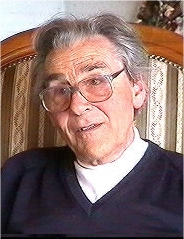 |
| Hans Kuhn (1919-1990) |
Question
3: Which are the major pillars of your theory?
Answer: The methodology
of biochemical retrodiction is the main pillar. It is in essence a methodology
of rational theory evolution. By this methodology my theory has greatly evolved
over the years. Some of the main features of my theory, which presently I consider
to be very important, may be summarized as follows. Life began as an autocatalytic,
chemo-autotrophic surface metabolism of low-molecular organic compounds. These
were formed first by CO fixation and later by CO2 fixation, in a volcanic setting
(CO, CO2, H2S, NH3) on the surfaces of colloidal inorganic precipitates of sulfides
of iron, nickel and other transition metals. The surface metabolism was driven
by the oxidative conversion of CO to CO2 and by a cascading oxidative conversion
of colloidal FeS with the end member FeS2. The primordial metabolism generated
organic constituents that became surface bonded in statu mascendi and that were
activated for further reaction. The surface metabolism evolved (self-expanded)
by the addition of autocatalytic feedback loops. This means that the dynamic analogue
information of feedback loops preceded the structural digital information of sequences.
In detail, the early evolution of life proceeded notably by self-lipophilization,
which later led to cellularization; and by ligand replacement notably by peptides
and later by coded proteins, which led to enzymatization. The enzymatization occurred
one by one. This means that the pre-enzymatic metabolic pattern was conserved
throughout the process of enzymatization and this is the reason why the method
of biochemical retrodiction is applicable down to the very origin of life.
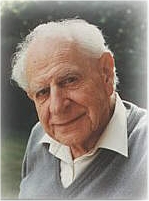 |
| Karl Popper (1902-1994) |
Question
4: Which are the weak points of the heterotrophic theory of the origin of life?
Answer A: For the following reasons a soup of organic compounds could never have
existed. (1) The atmosphere that would have been required for synthesis by discharges
never existed. (2) The presumptive organics in comets, meteors or the like could
not have survived the melting of the young Earth. (3) An ocean with organics could
not have survived the intense percolation through the very hot primordial crust
nor could an ocean with organics have survived the very intense volcanism or plate
tectonics creating massive sedimentation of volcanic dust.
Question
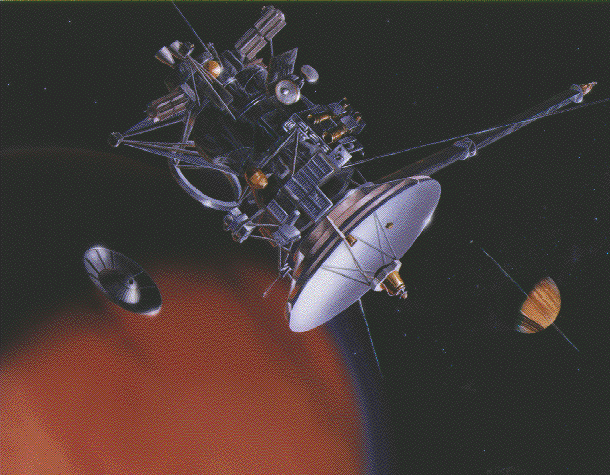
4.1 Nevertheless, there is a moon in our solar system with an atmosphere quite
similar to that used in Miller's experiments and with low temperatures. I am talking
about the moon Titan. Do you think that life could have started heterotrophically
on this moon.
Answer: I have to apologize. My knowledge about moon Titan
is very limited to say the least. For solving the problem of the origin of life
we have to solve a large number of problems in a coherent manner. Your question
about the moon Titan refers only to a small partial problem. Let us assume that
the atmosphere of the moon Titan is as in Millers experiments (H2O, NH3, CH4).
Let us further assume that the Miller reactions do go on in this atmosphere. Where
does this bring us? Only one question would be answered but none of the other
problems of a heterotrophic origin of life would be solved. What is worse, moving
from the Earth to moon Titan makes the other questions much more difficult to
answer or even unanswerable.
Answer B: More importantly, the notion of a
heterotrophic origin is paradoxical: At the moment of cellularization the formation
of a closed lipid membrane envelope would have hindered access of hydrophilic
or ionic organic nutrients. As a way around this problem it is frequently assumed
that the first lipid membranes were instable and leaky and somewhat permeable
for low molecular hydrophilic or ionic organic compounds. Since nutrition is undoubtedly
the most important requirement of an organism, subsequent evolution of the heterotrophic
cellular organisms would have been driven in the direction of more and more leaky
lipid membranes, which would have improved nutrition, but countermanded cellular
stability. Evolution in the opposite direction of less and less leaky, more and
more self-supporting lipid membranes would have improved cellularization, but
countermanded nutrition. This means that the cellularization of a heterotrophic
organism would have been a self-defeating process and therefore counter-selective,
unless jointly with cellularization a variety of membrane units for the membrane
transport of the various organic nutrients would have been ushered in, which is
improbable. So, no matter how we put it, cellularization of a heterotrophic organism
is a nutritional impossibility. An autotrophic origin with CO and/or CO2 as nutrients
does not run into this paradox. Evolution toward less and less leakiness would
not have hindered nutrition, since a lipid membran is permeable for CO and CO2.
Therefore the retaining function of the cell membrane could have been improved
by evolution without impairment of nutrition.
Answer C: Another paradox concerns
the activation of soup constituents. If they are reactive enough for undergoing
the reactions in the origin of life they are not stable in the soup due to hydrolysis
(at whatever temperature). If they are stable in the soup they are not reactive
for the origin.
Question
5: Which are the main experimental findings supporting your theory?
Answer: The main experimental findings: (1) Formation of H2 from FeS and H2S (Taylor
et al. J. inorg. nucl. Chem., 1979; Drobner et al., Nature, 1990 (2) Formation
of CH3SH from CO2 by FeS, if it holds (Heinen & Lauwers, Origins of Life,
1995); (3) CO fixation to acetylthioester in the presence of (Fe,Ni)S (Huber &
Wächtershäuser Science, 1997); (4) Pyruvate formation from FeS and CO
at high pressure, if it holds (Cody et al, Science, 2000); (5) Nitrogen fixation
by FeS (Weigand's group, Angewandte Chemie, 2003); (6) Reductive amination of
alpha-keto acids with NH3 on FeS in the absence of carbonate (Huber & Wächtershäuser,
Tetrah. Lett., 2003, revising Hafenbradl et al. Tetrah. Lett. 1995); (7) Formation
of peptides from amino acids with CO and (Fe,Ni)S (Huber & Wächtershäuser,
Science, 1998); (8) Metabolic peptide cycle with anabolic and katabolic segments
through purine-related hydantoin and urea derivatives on (Fe,Ni)S, catalytic for
and driven by the conversion of CO to CO2 (Huber et al., Science, 2003).
Question
6: Which is the significance of bacteria with internal pyrite grains? Has any
hybrid metabolism been discovered?
Answer: In the days of early over-enthusiasm
there was a precipitous report about bacteria with internal pyrite, but it has
been retracted.
Question 7: Which is the coupling system
proposed to use free energy of sulfide oxidation?
Answer: Oxidative pyrite
formation from FeS and H2S is an electron source and energy source. I suggested
that the electrons would be available for reduction reactions of the metabolic
autotrophic origin of life (Wächtershäuser, Syst. Appl. Microbiol.,
1988). Coupling would have occurred by electron transfer to generate first Fe3+
with a later conversion to pyrite. Incidentally, the long known formation of pyrite
from FeS and elemental sulfur, sometimes observed in microbial culture chambers
(Stetter et al. Syst. Appl. Microbiol. 1983; discussed in Wächtershäuser,
Syst. Appl. Microbiol. 1988), is not an electron source. Recently, and importantly,
CO as nutrient and the oxidative conversion of CO to CO2 have assumed center stage.
Coupling mechanisms have been suggested in Science 1998 and Science 2003.
Question
8: How do you overcome the Donnan effect? A constant internal and external
osmolality could exert an effect against evolution of semicellular organism towards
cytoplasmic metabolism, specially, it could stop the emergence of the genetic
machinery in this phase. Do you consider the posibility of non coded peptides
synthetized during the first phase acting as ionic channels?
Answer: Cellularization
must have occurred first by the lipophilization of the mineral (colloidal) surfaces
and later by mineral-supported membrane patches and still later by self-supporting
membranes with frequent fusions and fissions. As soon as stable membranes arose,
concentration gradients were the automatic result, which added another energy
source.
Question 9: From your point of view, which is the
role of temperature gradients formed in hydrothermal ambients? Could it have been
the origin of selforganized processes relevant for the origin of life?
Answer: Micro-organisms are too small to exploit a temperature difference or gradient
like a steam engine does. Everything depends on the presence of a chemical potential,
and later a chemical gradient across the cell membrane. The chemical potential
(non-equilibrium) is generated by fluid quenching from high temperature (e.g.
1500C) to low temperature (e.g. 100C).
Question 10: The
L-amino acid excess discovered in many meteorites has moved the biochirality problem
towards stellar radiation. Is this finding strong enough to damage irreversibly
your theory of bio-homochirality?
Answer: I now favor the view that biochirality
is due to feedback cycles on mineral surfaces in the course of the evolution of
the metabolism toward macromolecular structures (cf. Wächtershäuser,
Microbiol. Rev., 1988).
 |
| Louis Pasteur (1822-1888) |
Question
11: During recent past years biomarkers have raised strong controversy, specially
since McKay's ALH84001 results. Could we deduce some biomarkers from your theory?
Answer: Presently no theory is mature enough to suggest primordial biomarkers
that would justify spending very large sums of money. This would be a wild goose
chase with totally unpredictable results.
Question 12: Why,
until this date, can we not drive any successful assay to create life in the laboratory
as we think it is emerging currently? Because you think that currently life is
born as pyrite in anoxic way, is it not?
Answer: The recipe for the origin
of life is not complete in terms of catalysts. There has not been enough experimental
capacity for studying the catalyst systems for an autotrophic origin of life as
compared to the hundreds of millions that have been wasted in 60 years of soup
experiments by hundreds of groups. Extremely high pressure may be required. There
is presently no way to carry out experiments under CO flow conditions at extremely
high CO pressures, since CO is highly corrosive and since extremely compressed
CO gas is very dangerous.
Question 13: In such case, how
is the genetic code conserved? I mean, is P-Ser always associated with same codons
at the beginning?
Answer: I would like to rephrase your question as follows:
If the origin of life occurred continuously, why is there the astounding unity
of biochemistry? Due to the extreme simplicity of the pathways of an autotrophic
origin (1+1=2; 2+1=3; 2+2=4 etc.) the number of chemical possibilities at the
origin is extremely limited, virtually deterministic. This original unity of chemistry
is the basis for the later unity of biology. The next stage after the surface
metabolism is the stage of semi-cells that are still dependent on inorganic surfaces.
The semi-cells are not stably isolated from each other. They share their endowments
notably during the formation of the genetic machinery. The next discernable stage
is Otto Kandler's famous pre-cell stage. Pre-cells are independent of a mineral
support. They have a self-supporting lipid membrane, but they still undergo a
wholesale exchange of genetic endowments during fusion-fission processes within
now a greatly enlarged biosphere. This is the basis for the continued unity of
life up to and beyond the division into the three domains of life: Bacteria, Archaea
and Eukarya (see Wächtershäuser, Molecular Microbiology, 2003, 47, 13-23).
Question
14. So, the universality of the genetic code would be the result of homogenizing
processes applied to heterogeneous (diverse) immature genomes, restricted by the
unity of the autotrophic biochemistry in multiple origins. It would not be a clue
to a single (or common) origin fixed by an historic contingency. Is it not?
Answer: I believe that the extreme simplicity of an autotrophic origin of
life forces a chemically deterministic origin, which will be the same in all places
and at all times. The synthetic nature of the autotrophic processes is the reason
for the increase of complexity in the subsequent evolution. The increasing complexity
means an increase of reaction possibilities. The explosion of possibilities occurred
with the emergence of the genetic machinery. Let me use a metaphor. Life originated
in a narrow canyon of possibilities. At some point this canyon opened into a flat
terrain of genetic possibilities. These however are not totally free. They remain
somewhat restricted to the nature of the canyon and they remain in the area where
it opened into the plane.
Due to the important work by Wong we have to assume
that the genetic code emerged in a multi-step process in coevolution with the
evolution of the biosynthetic pathways to the amino acids. There is nothing that
forces us to assume that this protracted evolution ever led to "heterogeneous
(diverse) immature genomes". It might even have been chemically deterministic
all along. We simply do not know. All the precipitous statements about "frozen
accidents" or "historic contingency" in early evolution are premature
and perhaps have the effect of erecting walls against thinking.
Question
15. Therefore, this implies that life in other Earth-like planets as Mars or
Europa, if it exists or existed, will be very similar in terms of the genetic
machinery. What about the universal nature of the theories of the origin of life?
If we think the origin of life is an evolutionary chemical process, we need a
universal approach. Do you agree?
Answer: I fully agree. Chemistry is
a universal science. The laws of chemistry hold in all places and at all times.
They are independent of geography and calendar. They are not historic. This is
one of the fascinating difficulties: How did the universal chemical process turn
into an historic process?
Question 16.You based your theory
of the emergence of the two prokaryotic domains Bacteria and Archaea (Wächtershäuser,
Molecular Microbiology, 2003, 47, 13-23) on a lipid incompatibility. Briefly could
you explain what lipid incompatibility is?
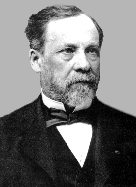
Answer: When Pasteur crystallized
tartaric acid from a solution he noticed that the racemic 50:50 mixture of the
tartaric acid separated into two homochiral crystal types, which he separated
with pincers under a microscope. Similarly it has been found that a 50:50 racemate
of lipids, when converted to a membrane separates into a 50:50 pattern of two
types of intermeshed homochiral membrane domains. This occurs by physico-chemical
forces alone and deterministically!
Question 17.Is there any
group working on experiments you proposed to potentially falsify your lipid membrane
evolution theory?
Answer: I do not know of any such group. But the group of
Koga in Japan is the best in the field and would be highly competent.
Question
18.Following Kandler's hypothesis is it possible for new domains (other than
Bacteria, Archaea or Eukarya) to emerge or have all the possibilities already
been explored with the three domains Bacteria, Archaea and Eukary?
Answer:
In my reading all possibilities have been explored. The domains Bacteria and Archaea
are due to the two lipid enantiomers. There are only two. The question of the
Eukarya is a little more difficult to answer. One might ask, if alternative "Eukarya"
could have come about by the endosymbiosis of Archaea and pre-cells with a predominance
of archaeal lipids. I tend to think that the structure of the archaeal lipids
made this impossible, while the structure of the bacterial lipids made it possible.
Question 19.To finalize, from your point of view, which
are the most relevant unanswered questions concerning the origin of life?
Answer: The answer depends on the theory you have in mind. In my theory the
most pressing question concerns the combination of parameters (temperature, pressure,
pH, ionic strength, nutrient types and concentrations as well as composition and
history of the catalysts) that would support an autocatalytic carbon fixation
process and its subsequent evolution. Once this is explored, the main problems
will be analytical.
D.S- Thank you very much. I hope this interview will be the begining of a productive and lovely debate in Huygens and beyond.
G.W- Thank you so much for your interest. Your questions have been very stimulating. It was a pleasure working with you.
A lo largo de un mes el Dr. Günter Wächtershäuser y yo hemos mantenido una entrevista por correspondencia electrónica tratando los principales argumentos sobre la hipótesis autotrófica del origen de la vida. El Dr. Wächtershäuser hace un completísimo repaso desde los orígenes de su teoría hasta los más recientes argumentos sobre el origen de los tres dominios de la vida. Abordamos también cuestiones relevantes para la Astrobiología.
|
| Gunter
Wachtershauser |
D.S.- Muchas gracias
Dr. Wächtershäuser por acceder a contestar mis preguntas. Estoy muy
orgulloso y espero que todo marche sobre ruedas. En primer lugar ¿Cuándo
comenzó a interesarse por el origen de la vida? ¿Cuáles fueron
sus fuentes de inspiración?
G.W- Comencé a interesarme
por el origen de la vida durante 1972/3, cuando como abogado de patentes leí
un artículo de mi primer profesor de física-química, Profesor
Hans Kuhn (RNA en rocas porosas). Fue publicado en "Angewandte chemie".
Entonces yo creía de forma ingenua en la teoría de la sopa primigenia
y que Kuhn fundamentalmente había resuelto el problema. A principios de
1973 me interesé profundamente por la epistemología de Karl Popper.
Tiempo después, en 1982 conocí a Karl Popper en persona. En los
años que siguieron a aquel primer encuentro Popper llegó a ser mi
más cercano amigo y mi mentor. Mi pensamiento ha estado profundamente influenciado
por Popper. De acuerdo con la filosofía del conocimiento de Popper, la
evolución cultural, dentro de la que se incluyen los descubrimientos científicos
y las invenciones técnicas, procede básicamente de la misma manera
que lo hace la evolución biológica: Como una concatenación
interminable de problemas e "intentonas" de solución dando lugar
a la emergencia de nuevos problemas, y así hacia delante. Me di cuenta
de que yendo hacia atrás en esta concatenación llegábamos
al origen de la vida como origen de todos los problemas. Entonces comencé
a desarrollar una teoría general de la evolución de los problemas,
la cual dejé apartada tiempo después. En 1982 William W. Bartley
III, pupilo de Popper, me invitó a dar una conferencia en un simposium
filosófico en Nueva York. En la conferencia (1983) relacioné el
trabajo de Hans Kuhn, desde un punto de vista metodológico, con la epistemología
de Karl Popper. Inspirado por los artículos de Bartley y el psicologista
Donald Campbell poco después (1983/4) escribí un manuscrito con
el título "Luz y vida" en el cual analizaba el origen de la percepción
visual y la fotosíntesis. El artículo se publicó en un volumen
filosófico (Wächtershauser, G. (1987) Light and life: on the nutrition
origins of sensory perception. In: Evolutionary Epistemology, Rationality and
the Sociology of Knowledge (Radnitzky, G. & Bartley III, W.W. eds.) pp. 122-138.
La Salle: Open Court). Este artículo marca los comienzos de mi metodología
de la "retro-dicción bioquímica". En 1982 y 1984 me encontré
con Carl Woese, uno de los fundadores de la teoría del mundo de RNA. Fui
presentado a Woese por uno de mis colaboradores, George Fox, quien había
venido a vernos a Munich y con quien llegué a estar emparentado cuando
su padre, que había enviudado, se casó con la madre de mi esposa,
también viuda. De Carl Woese aprendí que la teoría de la
sopa prebiótica estaba seriamente viciada y que el problema del origen
de la vida estaba lejos de estar resuelto, sin embargo, en aquella época
no podía ver ninguna alternativa a la teoría de la sopa y por lo
tanto permanecí cautivo por ella.